

Your company bought the licenses, ran the training, and watched AI usage climb. Everyone cheered. Then someone on the leadership team asked what the company was getting for the spend, and the usage dashboard stopped being a good enough answer.
It's a familiar problem as AI moves from experimentation to a meaningful budget line. Employees are using AI. Some are saving hours every week. But customer outcomes, operating costs, and team performance may look much the same as they did six months ago.
Individual productivity gains don't automatically add up to organizational returns. An employee can finish a task in half the time without changing how their team operates. A department can have enthusiastic users without a single shared AI workflow. And a company can be investing in skills that haven't yet translated into measurable business results.
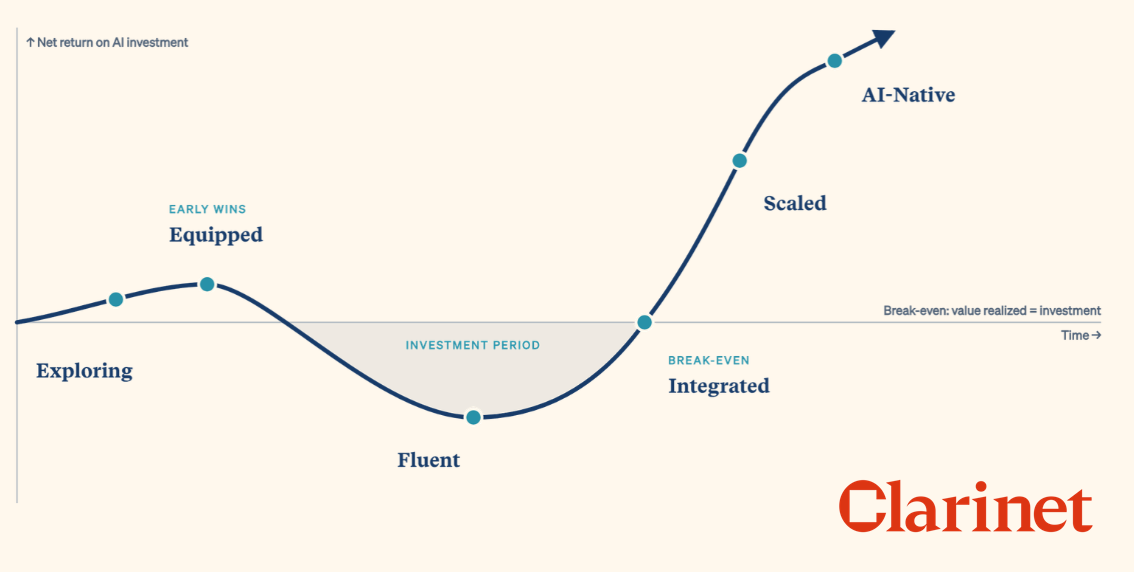
At Clarinet, we use the AI Transformation Curve to explain why progress can look uneven and help leaders decide the next steps their company needs to take in order to make progress towards ROI.
Why AI adoption and business value don't move together
There's a useful precedent in economics that explains the lag between adoption of a new technology and realized business value. Researchers Erik Brynjolfsson, Daniel Rock, and Chad Syverson developed the Productivity J-Curve to explain why the benefits of major technologies can take time to show up in productivity statistics. Technology alone isn't enough. Organizations also invest in skills, processes, and new ways of coordinating work, and those investments may initially be hard to see in the numbers.
Recent AI research points in a similar direction. In MIT CISR's 2025 research, the largest difference in financial performance between adjacent AI maturity stages appeared between companies building AI capabilities and those scaling new AI ways of working. And BCG's 2026 AI at Work survey found that employees at organizations reshaping workflows or developing new business models with AI were more likely to report measurable business improvements than employees at organizations focused on deploying tools (67% versus 43%).
The implication is practical: People need to get better at using AI, and organizations need to change how work gets done. Those things don't necessarily happen at the same pace. Skills may improve before workflows change; workflow gains may become visible before they affect financial results.
That lag is frustrating when leadership wants a clear return on the investment. It's also a reason to look more carefully at what kind of progress is happening.
The six stages of AI transformation
Most maturity models show a progression from experimentation to sophisticated use with a ladder showing increasing gains. Clarinet's AI Transformation Curve adds a question: Where is the value showing up in each stage?
It's a conceptual model informed by transformation research and our work with more than one hundred organizations building AI capability. The stages describe patterns of capability and the decisions that tend to come with them.
A company rarely sits neatly in one stage. Engineering may have redesigned core workflows while finance is still building baseline fluency. One department may have a reliable AI system while another has hundreds of licenses and little to show for them. Looking at maturity team by team provides a clearer, more actionable picture of what to focus on with each team in order to move the whole company forward.
The dip: When people get better at AI, but the organization doesn't
One distinction matters enormously in our work with organizations on AI transformation: People becoming more effective with AI doesn't guarantee the organization becomes more effective because of AI.
Imagine a customer success manager who learns to use AI to prepare for client calls. Research that took 30 minutes now takes ten. That's a useful win. But if everyone on the team develops their own approach, the gains stay largely personal. There may be no shared quality standard and no way to tell whether better preparation improves customer outcomes.
There's also the question of what happens to those 20 minutes. Has leadership said what the team should do with the capacity AI frees up? Without a clear priority, it can get absorbed by email, meetings, and the next low-value request. Everyone is a little more efficient, but that efficiency may never reach the work the company most wants to advance.
Now imagine the team builds a shared preparation workflow. It pulls together relevant account information, creates a draft brief, and gives employees an agreed standard for checking the result. The team can track preparation time and whether the briefs improve the quality of client conversations.
That moves the gain from an individual habit into something the team can improve, measure, and maintain.
We see two ways organizations can miss this transition. Some invest in training but leave employees to find their own applications, so the value remains scattered. Others rush toward agents and automations without clear processes, reliable inputs, or people equipped to exercise judgment over the results.
Both can slow progress. The aim is to develop workforce capability while redesigning the work where it matters most.
Four ways to close the gap between AI adoption and business value
1. Measure the progress that should be happening now
Usage is a useful early signal. It tells you whether people are engaging with AI, but not whether they're skilled or whether their work is improving. Financial ROI matters too, though it can take longer to emerge than changes in capability or workflow performance.
Match your measures to the progress you're trying to make. Early on, look at access, adoption, and barriers to use. As employees develop skills, assess applied AI fluency and quality, not just confidence. Once teams have shared workflows, track baselines for cycle time, accuracy, throughput, or customer experience. As those workflows scale, connect them to the outcomes leaders already review.
Capability can be improving in places your dashboard doesn't measure. The right measures help you distinguish an investment that's building toward results from one that needs to change course.
For more, see our guide to measuring the business impact of AI transformation.
2. Build fluency and redesign workflows together
We encounter two competing instincts. One is to train everyone first, then tackle workflows once the workforce is "ready." The other is to skip the fluency work and go straight to the exciting part: agents, automations, and the promise of ROI.
Both approaches leave something important out.
Training in isolation can produce employees who know how to use AI but haven't changed the work their teams do. Going straight to sophisticated systems creates a different risk: People may not know how to give those systems the right context, judge their outputs, recognize failure, or decide when a human needs to step in.
A better approach is to run the two efforts in parallel. Build foundational fluency broadly, with practice tied to employees' actual work. At the same time, choose a few recurring workflows worth improving and involve the people who own them in the redesign. Give builders deeper technical training where it's needed; don't expect everyone to become an agent developer.
Managers can connect the efforts by protecting practice time, asking teams what they've learned, and helping successful individual uses become shared practices.
The goal is to create progress on both sides: employees capable of using AI well, and work that's worth applying those skills to.
3. Turn individual wins into shared workflows, one at a time
Moving from individual productivity to team-wide impact is often where momentum stalls. It is easy for employees to discover useful shortcuts on their own, but turning those isolated habits into scalable, consistent team practices requires deliberate coordination and clarity.
Start with a recurring process where improving speed, quality, or capacity would matter. Before adding AI, get specific: What triggers the work? What inputs are required? What does good look like? Who owns the outcome, and where is human review essential? What baseline will tell you whether things improved?
Then redesign the workflow with the people who actually do it. They know the exceptions, missing information, and judgment calls that an outside team can easily miss. Once it's running, measure quality alongside efficiency. Faster work that creates more errors isn’t progress.
And decide where saved time should go. In BCG's 2026 survey, 66% of frontline employees reported limited or no guidance on how to use time freed by AI. If a task gets faster, will the team serve more customers, improve quality, or tackle a backlog? Hours saved without a destination don't necessarily become business value.
4. Make AI transformation part of how leaders manage the business
Visible executive AI use helps, but leaders have bigger responsibilities than demonstrating tools. They need to decide which problems matter most, what responsible use looks like, who owns new workflows, and how success will be judged.
Those decisions belong in normal management routines. Ask functional leaders to identify priority workflows. Review results against operating measures. Remove barriers around permissions, data, and coordination. Give employees room to experiment without expecting them to redesign the business on top of an already full workload.
For midsize organizations, fewer layers can make it easier to bring decision-makers and frontline teams together. Use that advantage to learn faster and put working improvements into practice.
Find out what's holding back your AI investment
AI transformation isn't a straight line, and recognizing that return can lag adoption is the first step toward making smarter investment decisions. When leaders understand exactly where their organization sits on the curve, they can stop guessing about what to fund or fix next.
To get started, ask yourself what is currently preventing your AI investment from translating into measurable business value. Is it foundational fluency, workflow design, clear ownership, proper measurement, or something else entirely?
If you're ready to get unstuck, schedule a 20-minute consultation with Clarinet. We'll help you map where your organization sits on the AI Transformation Curve and pinpoint the exact priorities that will drive your next stage of growth.